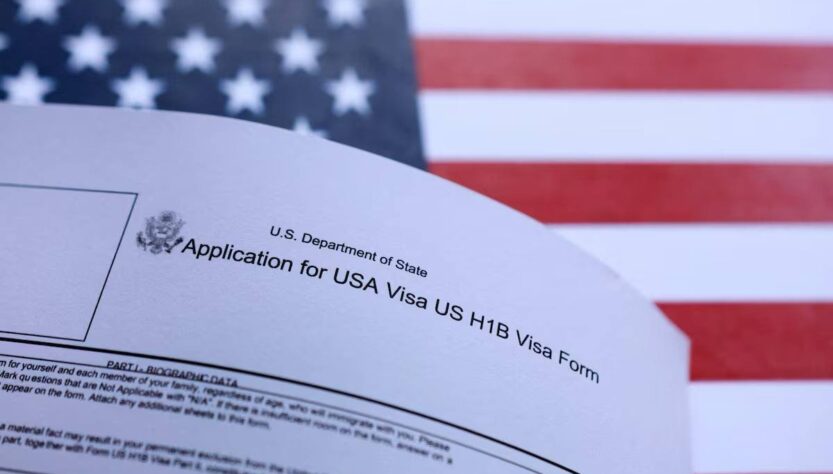
U.S. District Judge Haywood Gilliam Jr. ruled on Wednesday, Sept. 30, in Oakland, California, that federal agencies skipped required rulemaking steps before they started charging the fee. The decision stops U.S. Citizenship and Immigration Services and the State Department from enforcing it while the case continues.
A second federal judge has blocked President Trump’s unprecedented $100,000 fee on new H-1B visas for highly skilled foreign workers.
— Bittu Rohtak🇮🇳 (@bitturohtak) October 2, 2026
U.S. District Judge Haywood Gilliam ruled that federal agencies failed to follow required rule-making procedures before implementing the fee pic.twitter.com/x4r03AORnb
The ruling did not say the president’s goal was wrong. It said the government took a shortcut on paperwork. That difference matters, because the administration is already working on a permanent version that follows the rules.
What the fee is
President Trump created the $100,000 fee in a September 2025 proclamation. It applies to employers filing H-1B petitions for workers who are outside the United States, according to JURIST. Before that, H-1B fees ranged from about $2,000 to $5,000, the Associated Press reported in a story carried by Khaosod English.
The H-1B program offers 65,000 visas a year, plus 20,000 more for workers with advanced degrees. Visas are usually approved for three to six years.
The administration’s case is that companies have abused the program to replace American workers with cheaper foreign labor. In court, JURIST reports, the government argued the program enables abuse, “displacing qualified American workers and undermining the economy and national security.”
What the judge decided
Judge Gilliam found the plaintiffs were “likely to succeed” on their claim that the agencies “failed to comply with procedural requirements,” according to JURIST. Under the Administrative Procedure Act, agencies generally have to publish a proposed rule, take public comments and consider them before a new requirement takes effect. Law Commentary reports the judge found the agencies skipped those steps.
JURIST reports the block stays in place until the Department of Homeland Security finishes a formal notice-and-comment rule and completes an analysis of the effect on small businesses. Law Commentary reports the order covers both the original proclamation and Trump’s September 2026 extension of the fee.
The plaintiffs are a coalition of labor unions, employers and nonprofits that sued in October 2025. They include Global Nurse Force, a California company that recruits nurses. They are represented by the legal group Democracy Forward. “Today’s decision protects a system that was thrown into chaos overnight,” said Democracy Forward attorney Steve Bressler, according to the AP.
Not the first ruling
This is the second court to block the fee. In June, U.S. District Judge Leo Sorokin in Boston blocked it, and the First Circuit Court of Appeals refused to pause that ruling in July, according to Law Commentary.
Not every court has agreed. The AP reports that the U.S. Chamber of Commerce is appealing a separate ruling that rejected its argument that Trump lacked the authority to impose the fee at all.
Vice President JD Vance on H1-B visas:
— Vice President JD Vance (@VP) October 1, 2026
"If you’re going to bring in an accountant making $45,000 a year to replace an accountant who is an American making $60,000 a year, that’s not you using the program to bring in a genius. That’s you destroying American jobs and defrauding… pic.twitter.com/2yhrBzrnT8
A permanent rule is already in the works
The administration hasn’t waited for the courts. In August, DHS proposed a permanent H-1B fee of $103,265 through the formal rulemaking process, Law Commentary reports. That rule is now in its public comment period. If it is finalized properly, the procedural objection at the center of this week’s ruling could fall away.
The bottom line
Judge Gilliam’s ruling is about process, not principle. Nobody in this case proved that H-1B abuse isn’t real or that American workers aren’t being displaced. The judge found that the agencies moved too fast on paperwork. That is a fair point to raise in a nation of laws, and the administration is already fixing it with a formal rule that goes through public comment.
But the larger pattern is hard to miss. Groups that oppose the president’s agenda keep shopping for friendly courtrooms, and a single district judge can freeze national policy for months. Meanwhile, the question of whether big employers should pay a real price for bringing in foreign labor over qualified Americans goes unanswered.
The cleanest fix is for Congress to do its job. Lawmakers can write H-1B reform into law, set the fee themselves and end the courtroom tug-of-war. Until then, the administration should finish its permanent rule by the book and keep defending American workers in court.